



Welcome to our very first edition of On The Record, Pagefreezer's newsletter for investigators and OSINT practitioners. No one likes (or reads) long intros, so here's what's in our inaugural issue:
TL;DR
-
Your favorite OSINT tools are shutting down, being blocked, or getting $$$
-
Bellingcat links sleazy crypto ‘entrepreneur’ to non-consensual image forum
-
The latest on proposed AI-generated Evidence Rule 707
Let’s get into it.
OSINT TRADECRAFT UPDATES
RIP Your Favorite OSINT Tools
2026 OSINT Tool Graveyard. A tracker of 120+ tools found 10 shut down (BinaryEdge, ThreatCrowd, Nitter) and 6 moved behind paywalls. Time to audit your stack.
X's API pricing makes bad actor networks harder to detect. Pulls over 2 million posts now start around $50,000. Analysts warn that detecting disinformation networks is "extremely difficult" at these prices. Read the full analysis.
Wayback Machine losing ground. Publishers are blocking Internet Archive's crawlers to keep content out of AI training sets, also stripping it from the Wayback Machine, a beloved OSINT tool. Bummer. Read the Nieman Lab piece.
NOTABLE INVESTIGATION OF THE MONTH
NZ Crypto Bro Behind Non-Consensual Image Forum
Bellingcat links a crypto entrepreneur to LeakedBB, a non-consensual image forum with 2.2M registered users. Investigators traced DNS records, WHOIS history, and certificate transparency logs linking the forum to a Christchurch crypto entrepreneur, then corroborated through New Zealand company filings, archived social accounts, and a phone number match buried in old WHOIS records. The forum went offline two days after Bellingcat made contact.
LATEST LEGAL DEVELOPMENTS
Pause on AI-Generated Evidence Rule 707
What is it?
The rule would require that AI- or machine-generated evidence offered without a supporting expert witness meet the same reliability standards as expert testimony under Rule 702 — essentially closing a loophole where AI outputs (forensic algorithms, facial recognition, predictive software, etc.) got into evidence without the scrutiny experts normally face.
So what?
It's the single most consequential evidentiary change on the horizon for anyone submitting AI-touched material in US federal court.
Who cares?
Groups like the American Association for Justice pushed back hard, arguing the "machine-generated evidence" language was too broad and could sweep in routine digital evidence like geolocation data, surveillance video, or electronic health records.
What's next?
In June, The Standing Committee sent it back for revision and further study. They will combine it with related "deepfake" evidence issues and take it back up at the Fall 2026 meeting, with input from technologists and practitioners.
The Pagefreezer Takeaway:
Regardless of the outcome of the new rule, admissibility of digital evidence will always depend on whether you can prove it is what you say it is and it hasn't been tampered with after collection. Here's how you prove it:
- Capture everything, including surrounding context and metadata
- Attach certified timestamps
- Use SHA-256 hashing to make it tamper-evident
- Be meticulous about your documentation
And use WebPreserver for all your digital evidence capture, of course.
PAGEFREEZER CONTENT
3 Shameless Plugs-of-the-Month
-
If you’re not tapping into the world’s most widely used video-sharing platform, are you even OSINT-ing, bro? Check out our comprehensive YouTube OSINT Guide.
-
How does WebPreserver compare to screenshots and other evidence collection tools? We’re so glad you asked. Read our comparison breakdown.
-
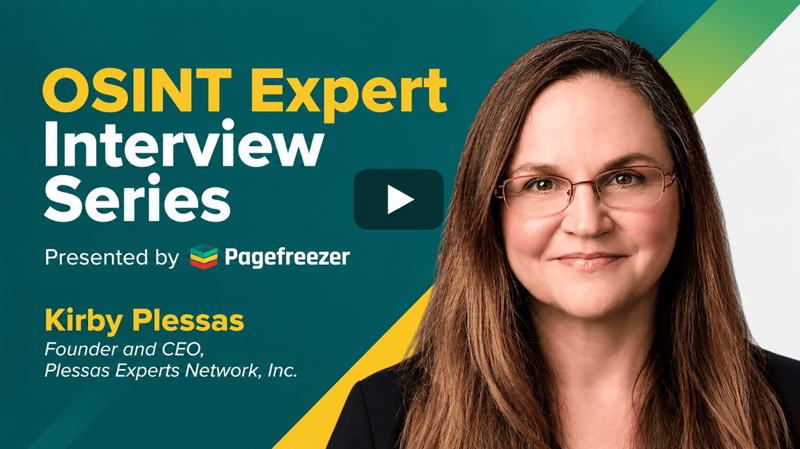
Kirby Plessas didn't set out to become one of the most influential OSINT experts in the world. She wanted to get into languages. Watch the full interview or read the transcript.
Want this newsletter delivered straight to your inbox? Click the link below to subscribe and never miss an issue.